
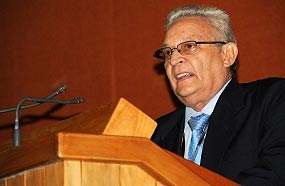
The university in the world has the challenge to cause social, scientific and technological changes from the promotion of humanistic values and committed to progress, said today the Cuban Minister of Higher Education, Rodolfo Alarcon.
Speaking of the challenges of the university education, during the International Congress Pedagogia-2013, Alarcon added that it must find ways to influence society in all areas in an increasingly decisive, permanent and effective way, according to the needs in different countries.
In a special speech before hundreds of delegates, in an event that brings together nearly 3,000 people from more than 30 countries, Alarcon considered a need to rescue the cutural value of education and beat the limited view that relegates it to a mere input of the production.
At the same time he called to mobilize to counteract the educational exclusion comfirmed in many countries, based on the premise that to access education is not only a human right but also a guarantee for participation in collective decision making.
Regarding to higher education in Cuba, Alarcon stressed that it is planed based on combining a high professional competition with the more altruistic revolutionary convictions, and prepare citizens for social performance.
The graduates must carry values that become competent professionals from ist theoretical and technical mastery, and be men of integrity capable of rising to the height of their time and meet the demands of the revolutionary process.
The Cuban university professor work aims to shape national values and a deep sense of humanism, while preserving, generates and promotes knowledge and skills, he added.
Alarcon also mentioned some data that illustrate the situation of higher education in Cuba, which is intended for 5.1 percent of gross domestic product and 10.4 of the total national budget.
Currently there are in the country 67 universities nationwide in which were studied 104 careers based in a model of broad profile, reported.
Since the triumph of the Revolution in 1959 the system has graduated over one million professionals, including more than 35,000 students from other countries, mostly in Latin America, the Caribbean and sub-Saharan Africa.