
News
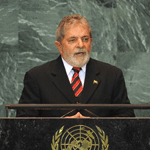
Heads of State Demand End of US Blockade against Cuba at U.N.
Brazil’s President Luiz Inácio Lula da Silva assured before the U.N. General Assembly that obsolete measures like the U.S. blockade of Cuba will remain in force until a political will to lift it emerges.
Fuente
Agencia Cubana de Noticias
Fecha
Brazil’s President Luiz Inácio Lula da Silva assured before the U.N. General Assembly that obsolete measures like the U.S. blockade of Cuba will remain in force until a political will to lift it emerges. Lula was the first speaker during the 64th session of the UN General Assembly underway in New York.
Likewise, Uruguayan President Tabare Vazquez reiterated that his country will continue working to achieve the integration of the Americas without exclusions, exceptions or blockades like the one Cuba is suffering, reported Granma newspaper.
Bolivia’s Evo Morales stressed that to change the world, the United Nations must be first changed and the blockade against Cuba lifted.On the other hand, the day before, U.S. President Barack Obama said a new era of commitment to the world should start and promised to work together with other nations while defending the interests of his country.
“The time has come for the world to move in a new direction. We must embrace a new era of engagement based on mutual interest and mutual respect, and our work must begin now,” said Obama in his speech to the Assembly.
Meanwhile, French President Nicolas Sarkozy said an agreement on a provisional reform of the UN’s Security Council should be reached before the end of the year. “The crisis compels us to show some imagination and audacity,” he said and added that given the current world situation in terms of politics, economy and the environment, the world needs a global government, reported EFE.
Libya’s leader Muammar el Kadafi also spoke out in favor of reforming the United Nations in a way so that the General Assembly becomes the main instrument of the organization and it assumes the UN Security Council’s prerogatives.
He said that according to the UN Charter, nations are equal, whether large or small, however, most of them are not represented in the Council.Both, the Secretary General of the organization, Ban Ki-moon, and the president of the General Assembly, Libyan diplomat Alí Treki, called to strengthen multilateralism.
Ban Ki-moon said: “If ever there were a time to act in a spirit of renewed multilateralism –- a moment to create a United Nations of genuine collective action –- it is now.”
Ban made reference to nuclear disarmament and the fight against poverty and climate change as a few of the most important aspects which the world organization must keep working on.
Meanwhile, Treki warned over current threats to peace and international security. He identified as challenges conflicts among states, civil wars, mass destruction weapons, terrorism, organized crime and environmental degradation, extreme poverty and the spreading of deadly infectious diseases.
Treki pledged to work with Member States to forge a consensus on a revitalized Assembly, a more representative and reformed Security Council, and other initiatives to improve the effectiveness and management of the Organization.
He also reaffirmed the Assembly’s commitment with the universal rather than selective nature of human rights.
Likewise, Uruguayan President Tabare Vazquez reiterated that his country will continue working to achieve the integration of the Americas without exclusions, exceptions or blockades like the one Cuba is suffering, reported Granma newspaper.
Bolivia’s Evo Morales stressed that to change the world, the United Nations must be first changed and the blockade against Cuba lifted.On the other hand, the day before, U.S. President Barack Obama said a new era of commitment to the world should start and promised to work together with other nations while defending the interests of his country.
“The time has come for the world to move in a new direction. We must embrace a new era of engagement based on mutual interest and mutual respect, and our work must begin now,” said Obama in his speech to the Assembly.
Meanwhile, French President Nicolas Sarkozy said an agreement on a provisional reform of the UN’s Security Council should be reached before the end of the year. “The crisis compels us to show some imagination and audacity,” he said and added that given the current world situation in terms of politics, economy and the environment, the world needs a global government, reported EFE.
Libya’s leader Muammar el Kadafi also spoke out in favor of reforming the United Nations in a way so that the General Assembly becomes the main instrument of the organization and it assumes the UN Security Council’s prerogatives.
He said that according to the UN Charter, nations are equal, whether large or small, however, most of them are not represented in the Council.Both, the Secretary General of the organization, Ban Ki-moon, and the president of the General Assembly, Libyan diplomat Alí Treki, called to strengthen multilateralism.
Ban Ki-moon said: “If ever there were a time to act in a spirit of renewed multilateralism –- a moment to create a United Nations of genuine collective action –- it is now.”
Ban made reference to nuclear disarmament and the fight against poverty and climate change as a few of the most important aspects which the world organization must keep working on.
Meanwhile, Treki warned over current threats to peace and international security. He identified as challenges conflicts among states, civil wars, mass destruction weapons, terrorism, organized crime and environmental degradation, extreme poverty and the spreading of deadly infectious diseases.
Treki pledged to work with Member States to forge a consensus on a revitalized Assembly, a more representative and reformed Security Council, and other initiatives to improve the effectiveness and management of the Organization.
He also reaffirmed the Assembly’s commitment with the universal rather than selective nature of human rights.