
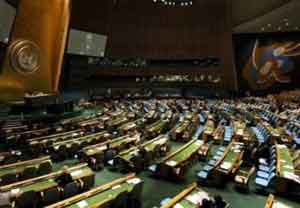
The fourth day of discussions at the U.N. General Assembly heralds today a new series of highest level condemnations against the U.S. blockade on Cuba.
Peruvian Foreign Minister Condemns US Blockade of Cuba.
The last statement heard during the plenary session was that made last night by Peruvian Foreign Minister Rafael Roncagliolo Orbegoso, where he repudiated that siege to the Caribbean nation.
The Peruvian diplomat stated that the U.S. economic, trade and financial blockade is unjust, illegitimate and illegal, and recalled it remains despite the countless condemnations by the General Assembly itself.
Before, Solomon Islands' Prime Minister Gordon Darcu Lilo reiterated his support for the international clamor for lifting the blockade against Cuba, and thanked the Caribbean country's collaboration in training physicians from that Pacific island.
The head of government of Antigua and Barbuda, Winston Baldwin Spencer, sued Washington the immediately and unconditionally end to the blockade against the Cuban people.
He argued that the continuation of such measure destroys the nations' hopes in solving world affairs, and recalled the successive demands by the U.N. General Assembly for its lifting.
Guyana's President Donald Rabindranauth Ramotar wanted "to express its strong opposition" to the U.S. siege against the Caribbean nation, and highlighted the progresses Cuba has achieved in its development.
Shortly before, Equatorial Guinea's head of State Teodoro Obiang Nguema said that measures like those cause human suffering, and are in contradiction with the Millennium Development Goals adopted by the United Nations.
Meanwhile, Prime Minister of Jamaica, Portia Simpson Miller, repudiated the long economic and trade embargo against Cuba, and highlighted the severe negative effects on the growth and development of that country and its development.
Lesotho's Prime Minister Thomas Motosoahae Thabane also criticized that the request made during 20 years to lift the U.S. siege against Cuba has not been heard.
The complaint to the U.S. blockade was established in the meeting since the beginning of debates by Brazilian President Dilma Rousseff, who said "it's time to end that anachronism, which is condemned by the U.N. members' majority."
The rejection of that siege for half a century was also presented at the plenary session by the heads of State of Namibia, South Africa, El Salvador, Gabon, Ghana, Gambia, and Bolivia, among others.