
Nachrichten
New Policies to Update Cuban Economic Model Examined
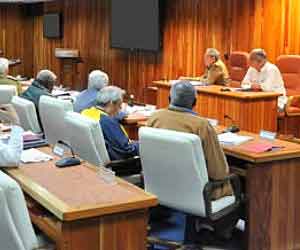
The Cuban Council of Ministers examined new policies, control actions and procedures to support the updating of the economic model of the island, informed today Granma daily.
Quelle
Prensa Latina
Datum
The Cuban Council of Ministers examined new policies, control actions and procedures to support the updating of the economic model of the island, informed today Granma daily.
The meeting headed by president Raul Castro was held Thursday and ministers detailed the strategies for a more rational use of water, recycling of raw materials and the flexibilization of corporate objectives.
Regarding the first point on the agenda, the president of the National Institute of Water Resources (INRH), Ines Maria Chapman, proposed to develop a National Policy on Water, with an economic focus and the adoption of strategies on the part of both the state entity and consumers.
The proposed policy prioritizes the use of water: for human consumption and livestock, agricultural irrigation and food production, industries, fish farming, recreational and environmental use, stresses the newspaper.
At present, the State subsidizes water supply, but studies made on the present situation regarding consumption of the vital liquid, show that a high percentage of the water pumped each year is wasted without a chance to recover it, she assured.
On his part, the minister of Industry, Salvador Pardo, presented a diagnosis on the recycling of raw materials, as well as the initiatives of that sector for the application of incentives, economic instruments and new management models.
The Minister elaborated on the difficulties to recover raw materials, as the unexistence of a recycling policy, the application of non incentivating prices for some recyclable products and not enough outlets to buy raw materials from the population, among others, says the newspaper.
Recycling -he said- is the best way to handle waste generated by the population, that is why we will prioritize planning investments those related to recycling of raw materials, he added.
Regarding this point, he explained the Ministry is working on updating the Law of Recycling of 1975, which highlights the importance of social responsibility to be applied in the productive sector and the population, including the study of the State function to seize abandoned machinery and undeclared scrap metal.
The head of the Permanent Commission for the Application and Development of Economic Guidelines, Marino Murillo, explained the policy to make more flexible the corporate objectives, which is directed to enhance the potential of economic enterprises without hindering the fulfilment of their fundamental missions.
He also informed on the recent control process carried out on different legal instruments related to the extinction of the Ministry of the Sugar Industry, as well as the creation and functions of the Sugar Group.
Also, Comptroller General of the Republic, Gladys Bejerano, briefed about the results of Integral State Controls carried out in the Ministries of Tourism and the Food Industry to verify their performance and evaluate the efficiency with which they fulfill the Plan of the Economy and the State Budget.
In conclusion, Raul Castro referred to the plan of the economy for 2013 and extolled the importance to prioritize those investments that generate fast revenues, to impact directly on food production, import substitution and the increase of exports.
The meeting headed by president Raul Castro was held Thursday and ministers detailed the strategies for a more rational use of water, recycling of raw materials and the flexibilization of corporate objectives.
Regarding the first point on the agenda, the president of the National Institute of Water Resources (INRH), Ines Maria Chapman, proposed to develop a National Policy on Water, with an economic focus and the adoption of strategies on the part of both the state entity and consumers.
The proposed policy prioritizes the use of water: for human consumption and livestock, agricultural irrigation and food production, industries, fish farming, recreational and environmental use, stresses the newspaper.
At present, the State subsidizes water supply, but studies made on the present situation regarding consumption of the vital liquid, show that a high percentage of the water pumped each year is wasted without a chance to recover it, she assured.
On his part, the minister of Industry, Salvador Pardo, presented a diagnosis on the recycling of raw materials, as well as the initiatives of that sector for the application of incentives, economic instruments and new management models.
The Minister elaborated on the difficulties to recover raw materials, as the unexistence of a recycling policy, the application of non incentivating prices for some recyclable products and not enough outlets to buy raw materials from the population, among others, says the newspaper.
Recycling -he said- is the best way to handle waste generated by the population, that is why we will prioritize planning investments those related to recycling of raw materials, he added.
Regarding this point, he explained the Ministry is working on updating the Law of Recycling of 1975, which highlights the importance of social responsibility to be applied in the productive sector and the population, including the study of the State function to seize abandoned machinery and undeclared scrap metal.
The head of the Permanent Commission for the Application and Development of Economic Guidelines, Marino Murillo, explained the policy to make more flexible the corporate objectives, which is directed to enhance the potential of economic enterprises without hindering the fulfilment of their fundamental missions.
He also informed on the recent control process carried out on different legal instruments related to the extinction of the Ministry of the Sugar Industry, as well as the creation and functions of the Sugar Group.
Also, Comptroller General of the Republic, Gladys Bejerano, briefed about the results of Integral State Controls carried out in the Ministries of Tourism and the Food Industry to verify their performance and evaluate the efficiency with which they fulfill the Plan of the Economy and the State Budget.
In conclusion, Raul Castro referred to the plan of the economy for 2013 and extolled the importance to prioritize those investments that generate fast revenues, to impact directly on food production, import substitution and the increase of exports.