
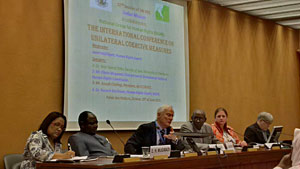
Cuba has expressed here its rejection to all unilateral coercive measures as incompatible with the principles of international law established in the United Nations Charter.
These provisions directly violate the sovereignty of States and the basic principles of the multilateral trading system, Anayansi Rodriguez, the islandâ�Ös permanent representative to the United Nations Office in this Swiss city, said during an event parallel to the 32nd session of the Human Rights Council, whose sessions continue today.
Such measures could particularly harm the economies of developing countries, creating an unfavorable global effect for achieving better economic and social realities and enjoying human rights, she stressed.
The countries that impose those measures say that what they supposedly want is to promote and protect human rights. However, the negative effects on these latter are sufficiently clear, especially in the field of economic, social and cultural rights and the right to development, Rodriguez stated.
She noted that Cuba, whose people have been suffering an economic, commercial and financial blockade (imposed by the United States) for more than 55 years, is well aware of the damage those unilateral coercive measures could cause.
That blockade on the island is the main obstacle to the implementation of the right to development of her people, she said.
The diplomat stressed that the blockade on the Caribbean nation has been so far applied, it has caused several damages to the population and it has been the main obstacle for the development of the Cuban economy.
It violates international law and its extraterritorial application has affected the interests of all States, she said.
That's why we keep on asking the international community to continue supporting Cuba in its struggle against the blockade, she said.
The 32nd session of the Human Rights Council will end on July 1.