
Notícias
Cuban VP Asseses Recovery Process in Ciego de Avila
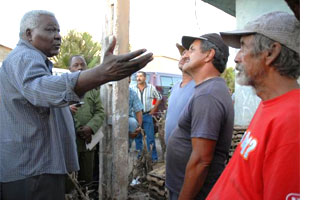
Cuban Vice President Esteban Lazo visited this Sunday central Ciego de Avila province to assess the recovery process from the wake of Hurricane Ike that battered this region last September.
Fonte
ACN
Data
Cuban Vice President Esteban Lazo visited this Sunday central Ciego de Avila province to assess the recovery process from the wake of Hurricane Ike that battered this region last September.
During his tour, residents spoke to Lazo about food production destined for several other provinces and about the conclusion of several economic and social projects as a tribute to the 50th anniversary of the Cuban revolution, reported Granma newspaper in its digital version.
Lazo spoke with residents from the community of Pesqueria where the La Cuba Farm Company is based. The farm is an important producer on the national level, supplying root and other vegetables to several provinces. It was severely damaged from the storm, but now shows vibrant
signs of recovery —good news in a country where most of the harvests were wiped out after three consecutive major hurricanes recently swept the island.
“I was worried after the hurricane whipped through here, but I’ve seen what people can do when they work with heart and determination. You have worked hard to recover and have achieved your goal,” said Lazo.
Lazo also visited the municipality of Venezuela and inspected a project that is constructing 20 “petro houses” —built using derivatives from the oil industry— as part of an agreement between Cuba and Venezuela under the Bolivarian Alternative for the Americas (ALBA).
Lazo also visited the Juventud Heroica Farm Company. An official from the provincial ministry of Agriculture, Benito Migoya Diaz, explained how after several years of difficulties the firm is now showing positive results and a leader in planting the next potato crop.
At the end of his tour of the farms, Lazo participated in a political-cultural event to commemorate November 29, 1895, the day in which General Maximo Gomez Baez crossed the fortified military road between Jucaro and Moron. On the following day, he formed the Ejercito Invasor on the fields of Lazaro Lopez to continue the war of independence westward.
During his tour, residents spoke to Lazo about food production destined for several other provinces and about the conclusion of several economic and social projects as a tribute to the 50th anniversary of the Cuban revolution, reported Granma newspaper in its digital version.
Lazo spoke with residents from the community of Pesqueria where the La Cuba Farm Company is based. The farm is an important producer on the national level, supplying root and other vegetables to several provinces. It was severely damaged from the storm, but now shows vibrant
signs of recovery —good news in a country where most of the harvests were wiped out after three consecutive major hurricanes recently swept the island.
“I was worried after the hurricane whipped through here, but I’ve seen what people can do when they work with heart and determination. You have worked hard to recover and have achieved your goal,” said Lazo.
Lazo also visited the municipality of Venezuela and inspected a project that is constructing 20 “petro houses” —built using derivatives from the oil industry— as part of an agreement between Cuba and Venezuela under the Bolivarian Alternative for the Americas (ALBA).
Lazo also visited the Juventud Heroica Farm Company. An official from the provincial ministry of Agriculture, Benito Migoya Diaz, explained how after several years of difficulties the firm is now showing positive results and a leader in planting the next potato crop.
At the end of his tour of the farms, Lazo participated in a political-cultural event to commemorate November 29, 1895, the day in which General Maximo Gomez Baez crossed the fortified military road between Jucaro and Moron. On the following day, he formed the Ejercito Invasor on the fields of Lazaro Lopez to continue the war of independence westward.